



참고 링크
원문
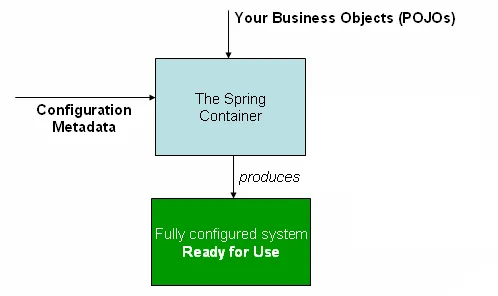
The interface org.springframework.context.ApplicationContext represents the Spring IoC container and is responsible for instantiating, configuring, and assembling the beans.
The container gets its instructions on what objects to instantiate, configure, and assemble by reading configuration metadata.
The configuration metadata is represented in XML, Java annotations, or Java code.
It lets you express the objects that compose your application and the rich interdependencies between such objects.
Several implementations of the ApplicationContext interface are supplied with Spring.
In standalone applications, it is common to create an instance of ClassPathXmlApplicationContext or FileSystemXmlApplicationContext.
While XML has been the traditional format for configuration metadata, you can instruct the container to use Java annotations or Java code as metadata instead, by using the AnnotationConfigApplicationContext or by registering @Configuration classes.
The following example shows a simple way to configure, instantiate, and use the container in Java:
package com.example.core;
import org.springframework.context.ApplicationContext;
import org.springframework.context.support.ClassPathXmlApplicationContext;
import com.example.core.services.HelloWorldService;
public class HelloWorldApp {
public static void main(String[] args) {
ApplicationContext context = new ClassPathXmlApplicationContext("beans.xml");
HelloWorldService service = context.getBean("helloWorldService", HelloWorldService.class);
service.sayHello();
}
}
Java
복사
And here is the same example written in Kotlin:
package com.example.core
import org.springframework.context.support.ClassPathXmlApplicationContext
import com.example.core.services.HelloWorldService
fun main() {
val context = ClassPathXmlApplicationContext("beans.xml")
val service = context.getBean("helloWorldService", HelloWorldService::class.java)
service.sayHello()
}
Kotlin
복사
The beans.xml file contains the configuration metadata that tells the container how to instantiate and configure the beans:
<?xml version="1.0" encoding="UTF-8"?>
<beans xmlns="http://www.springframework.org/schema/beans"
xmlns:xsi="http://www.w3.org/2001/XMLSchema-instance"
xsi:schemaLocation="
http://www.springframework.org/schema/beans
https://www.springframework.org/schema/beans/spring-beans.xsd">
<bean id="helloWorldService" class="com.example.core.services.HelloWorldService"/>
</beans>
XML
복사
The ApplicationContext is usually loaded at application startup and remains alive throughout the lifecycle of the application.
It manages the complete lifecycle of beans — from creation to destruction — and resolves dependencies between them.
번역
org.springframework.context.ApplicationContext 인터페이스는
Spring IoC 컨테이너를 나타내며,
빈(bean)의 생성, 설정, 조립을 담당한다.
컨테이너는 어떤 객체를 생성하고 설정하며
연결하지를 설정 메타데이터(configuration metadata)를 읽어
파악한다. 이 설정 메타데이터는 XML, Java 애노테이션, 또는 Java 코드 형태로 표현될 수 있다.
즉, 애플리케이션을 구성하는 객체들과 그들 간의 복잡한 의존 관계를 선언적으로 표현할 수 있게 해준다.
Spring은 ApplicationContext 인터페이스의 여러 구현체를 제공한다.
독립 실행형(standalone) 애플리케이션에서는 일반적으로
ClassPathXmlApplicationContext나 FileSystemXmlApplicationContext 인스턴스를 생성한다.
XML이 전통적인 설정 방식이지만, AnnotationConfigApplicationContext를 사용하거나 @Configuration 클래스를 등록함으로써 Java 애노테이션 또는 Java 코드 기반 설정을 사용할 수도 있다.
다음은 Java로 작성된 간단한 Spring 컨테이너 구성 및 사용 예시이다.
package com.example.core;
import org.springframework.context.ApplicationContext;
import org.springframework.context.support.ClassPathXmlApplicationContext;
import com.example.core.services.HelloWorldService;
public class HelloWorldApp {
public static void main(String[] args) {
ApplicationContext context = new ClassPathXmlApplicationContext("beans.xml");
HelloWorldService service = context.getBean("helloWorldService", HelloWorldService.class);
service.sayHello();
}
}
Java
복사
이 예제에서는 beans.xml 파일을 통해 컨테이너를 초기화하고,
HelloWorldService 빈을 가져와(getBean) 메서드를 호출한다.
즉, Spring 컨테이너가 객체의 생성과 의존성 관리를 모두 담당한다.
같은 예제를 Kotlin으로 표현하면 다음과 같다
package com.example.core
import org.springframework.context.support.ClassPathXmlApplicationContext
import com.example.core.services.HelloWorldService
fun main() {
val context = ClassPathXmlApplicationContext("beans.xml")
val service = context.getBean("helloWorldService", HelloWorldService::class.java)
service.sayHello()
}
Kotlin
복사
Kotlin 버전에서도 동작 원리는 동일하다.
ApplicationContext를 생성하고, 등록된 빈을 조회한 뒤(getBean),
메서드를 호출함으로써 의존성 주입이 작동한다.
다음은 컨테이너 구성을 정의한 beans.xml 예시이다
<?xml version="1.0" encoding="UTF-8"?>
<beans xmlns="http://www.springframework.org/schema/beans"
xmlns:xsi="http://www.w3.org/2001/XMLSchema-instance"
xsi:schemaLocation="
http://www.springframework.org/schema/beans
https://www.springframework.org/schema/beans/spring-beans.xsd">
<bean id="helloWorldService" class="com.example.core.services.HelloWorldService"/>
</beans>
XML
복사
이 설정 파일은 helloWorldService 빈이 com.example.core.services.HelloWorldService 클래스로부터 생성되어야 함을 지정한다. 컨테이너는 이를 읽고 해당 클래스를 인스턴스화하여 관리한다.
일반적으로 ApplicationContext는 애플리케이션 시작 시 로드되며, 애플리케이션의 전체 생명주기 동안 유지된다. 컨테이너는 빈의 생성부터 소멸까지의 전 과정을 관리하며, 빈 간의 의존 관계를 자동으로 해결(autowire)한다.